A personalised gold plated necklace is a customised piece of jewellery in which a base metal chain and pendant are coated with a thin layer of gold and then engraved, stamped or set with a stone to carry a name, initial, date or birthstone. In the UK market the term covers a wide range of quality, from thin flash plating on brass to five-micron coatings over sterling silver.
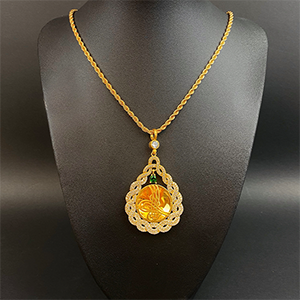
- A gold coating of at least 2.5 microns over a sterling silver base is the accepted threshold for the term vermeil in the UK.
- UK rules limit nickel release from jewellery in prolonged skin contact to 0.5 micrograms per square centimetre per week, tested to EN 1811.
- Gold plated jewellery is not hallmarked as gold in the UK because the coating is far too thin to meet assay office thresholds.
- Light fashion plating on necklaces typically measures 0.3 to 0.5 microns, compared with one to three microns for heavier commercial plating.
Table of Contents
- What is a personalised gold plated necklace?
- How thick is the gold plating, and how long will it last?
- Which chain length and style works best in the UK?
- What personalisation options can you choose?
- Is gold plated jewellery suitable for sensitive skin?
- What should a personalised gold plated necklace cost in the UK?
- How should you care for an engraved plated necklace?
- Buying a personalised necklace as a gift
- Frequently Asked Questions
Before you settle on a font or a birthstone, it helps to know what actually separates gold plated jewellery that doesn't tarnish from pieces that look tired within a few wears.
What is a personalised gold plated necklace?
A personalised gold plated necklace is a base-metal chain and pendant coated in a thin layer of gold, then customised with an initial, name, date or birthstone.
The construction is simple but the variables matter. A base alloy — commonly brass, copper or stainless steel — is electroplated with gold, and the finished piece is then engraved, stamped or set with a stone. The personalisation is what turns a mass-produced item into something that belongs to one wearer.
Because there is no legal definition of the phrase in the UK, sellers apply "gold plated" to everything from a £12 initial pendant to a heavily coated vermeil chain. Two necklaces can look identical in a photograph and behave completely differently after six months of daily wear.
That is why it pays to ask about plating thickness and base metal before buying, rather than judging from the finish alone.
How thick is the gold plating, and how long will it last?
The thicker the gold coating in microns, the longer the necklace keeps its colour, with anything from 2.5 microns upward classified as vermeil when applied over sterling silver.
Plating thickness is measured in microns (µm) and is the single most useful number a seller can give you. Light fashion plating sits around 0.3–0.5 microns. Heavier commercial plating runs to one, two or three microns, and the difference in wear is noticeable within months.
In the UK, a gold coating of at least 2.5 microns over a sterling silver base can properly be called vermeil. That is a different product from a thin flash plate over brass, and it should be priced accordingly.
Realistically, a daily-wear plated necklace with average plating will show wear at friction points — the clasp, the pendant loop, the back of the neck — somewhere between six and eighteen months. Plating does not fail evenly; it fails where the metal rubs.
Which chain length and style works best in the UK?
Most UK buyers choose an 18 inch chain for everyday wear, a 16 inch for a higher neckline and a 20–22 inch length for layering.
Chain length is the detail people most often get wrong, because it changes where the pendant sits on the chest. UK retailers generally work to these conventions:
- 14 inches (35 cm) — a choker fit, mostly used for children's pieces.
- 16 inches (40 cm) — sits at the base of the throat and suits a high or round neckline.
- 18 inches (45 cm) — rests just below the collarbone and works with most outfits.
- 20–22 inches (50–55 cm) — falls to the upper chest, ideal for layering or wearing over a jumper.
- 24 inches and above — a deliberate statement length, often paired with longer drop motifs.
If the necklace is a surprise gift, 18 inches is the safest default. It suits most adults and rarely looks either tight or lost.
What personalisation options can you choose?
Engraved or stamped metal is the most hard-wearing personalisation, while printed or resin-filled lettering is cheaper but fades sooner.
The most durable personalisation is engraved or stamped directly into the metal, because there is no added material to flake or discolour. Laser engraving handles fine script and small symbols; hand stamping gives a softer, slightly irregular look that many buyers prefer for initial pendants.
Other popular choices include birthstones and cubic zirconia settings, handwritten signatures reproduced from a photograph, and cut-out names made from sheet metal. Resin-filled or printed lettering looks sharp when new but tends to fade within a year of everyday wear.
Check the character limit before ordering. Most pendants comfortably take one to three initials, or a name of up to about ten characters, on each face.
Is gold plated jewellery suitable for sensitive skin?
Plated necklaces are usually fine for sensitive skin, provided the base alloy meets UK nickel release limits — the gold coating itself is rarely the irritant.
Skin reactions to plated jewellery are almost never caused by the gold. They come from nickel migrating through the coating from the base alloy. Under UK REACH rules, items intended for prolonged skin contact must release no more than 0.5 micrograms of nickel per square centimetre per week, tested to the EN 1811 standard.
If you have reacted before, look for pieces described as nickel-free, or choose a stainless steel or sterling silver base. Bear in mind that plating wears at friction points, so even a compliant necklace can expose the base metal after a year of daily wear.
Behind-the-ear or wrist testing is unreliable. Ask the seller what the base alloy is and how thick the plating is — a straightforward maker will answer plainly.
What should a personalised gold plated necklace cost in the UK?
Expect to pay around £15–£40 for a personalised plated pendant in the UK, rising to roughly £45–£120 for heavier plating or vermeil.
Prices cluster into three rough bands. A plated brass pendant with basic engraving usually lands between £15 and £40. Heavier plating, better clasps or a vermeil base pushes the price to roughly £45–£120. Solid 9ct gold pieces start well above £150, because there you are paying for metal rather than for a coating.
Be cautious of anything advertised as gold plated for under about £10. At that price the coating is likely a flash plate measured in fractions of a micron, and the finish will not survive regular wear.
Also check what is included. Free engraving, a gift box, a polishing cloth and a chain upgrade can shift the real value of two similarly priced necklaces considerably.
How should you care for an engraved plated necklace?
Keeping a plated necklace dry, putting it on after cosmetics and storing it sealed will noticeably extend the life of the gold layer.
Plated jewellery responds well to a simple routine. Put the necklace on last, after perfume, hairspray and moisturiser have dried, and take it off first at night. Perfume and sunscreen are two of the most common causes of premature dulling.
Keep the piece dry. Showering, swimming and washing up all expose the coating to chlorinated or soapy water that speeds up tarnishing. If you want something you rarely need to remove, look specifically at waterproof pieces.
Store the necklace in a sealed pouch or a lined box rather than loose in a drawer, where it will rub against other chains. A soft dry cloth restores most of the shine; abrasive polishes and ultrasonic cleaners should be avoided because they strip the gold layer.
Buying a personalised necklace as a gift
Personalised plated necklaces are mainly bought as gifts in the UK, with Christmas, Valentine's Day and Mother's Day driving most orders.
Personalised jewellery is bought as a gift far more often than as a self-purchase in the UK, and the calendar drives demand. Christmas, Valentine's Day, Mother's Day and milestone birthdays — 18th, 21st, 30th and 40th — account for the bulk of engraving orders.
Ordering early matters more than usual because personalisation adds production time. Allow roughly two to three weeks for engraving plus UK delivery during peak periods, and check whether the seller offers tracked or named-day delivery.
When giving an engraved piece, include the order confirmation so the recipient can exchange the chain length if it does not sit right. A pendant that suits one wearer can hang awkwardly on another.
If you are still weighing up shapes, a row of gold plated necklaces shown at true scale makes those proportions far easier to judge than a single product photo.
Frequently Asked Questions
Is a personalised gold plated necklace worth it compared with solid gold?
If the design is sentimental and worn occasionally, yes — you get a custom piece for a fraction of the cost. If you intend to wear it daily for years, heavier plating or vermeil will last longer, and solid gold remains the only option that never wears through.
Will a gold plated necklace turn my skin green?
A green mark is usually a reaction between skin acids and the copper in the base alloy, not the gold itself. It is harmless, washes off, and is most likely on cheap plating that has already worn thin at the clasp or pendant loop.
Can I shower or swim while wearing a plated necklace?
It is best avoided. Soap, chlorine and salt water accelerate tarnishing and weaken the bond between the gold layer and the base metal. If you want a piece you can wear in water, choose one explicitly described as waterproof.
How long does engraving take in the UK?
Most UK sellers complete engraving within two to five working days, then add delivery on top. During the run-up to Christmas or Valentine's Day, allow two to three weeks in total to be safe.
Do personalised necklaces qualify for returns?
Engraved or made-to-order items are usually excluded from standard change-of-mind returns, so check the seller's terms before ordering. Faults and engraving errors are still covered, so keep your order confirmation.
Measure the chain before you engrave
Lay a necklace the recipient already wears flat, measure it end to end, and put that exact length in the order notes so the engraved piece arrives ready to wear.
See more