A kibrit çöpü bracelet — Turkish for "matchstick bracelet" — is an ultra-slim cylindrical bangle whose even, tube-shaped profile is roughly as thin as a wooden matchstick. Finished in rose gold tone, that narrow silhouette reads as delicate rather than heavy, which is why the style has become a staple of modern stacking. This guide explains the widths, sizing, care, and buying questions that matter most for shoppers in the United States.
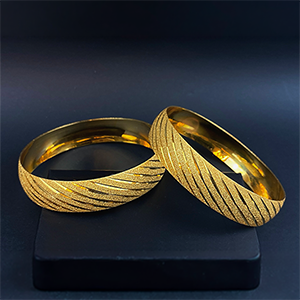
- A kibrit çöpü (matchstick) bracelet is typically 3 to 5 millimeters wide, narrower than the 1 centimeter entry point of standard Turkish bangles.
- Copper is the alloying metal that gives rose gold its pink tone; a higher copper content produces a deeper, redder color.
- Most adult women's bangle diameters fall between about 2.4 and 2.7 inches, or 60 to 68 millimeters.
- Plated jewelry finishes are measured in microns and wear through faster with daily contact, water, and metal-on-metal abrasion.
Table of Contents
- What Is a Kibrit Çöpü (Matchstick) Bracelet?
- Why Does Rose Gold Look Different from Yellow Gold?
- How Do Matchstick Bracelets Compare to Wider Bangles?
- How Do You Choose the Right Bangle Size?
- How Do You Stack Rose Gold Matchstick Bracelets?
- How Should You Care for Rose Gold-Plated Jewelry?
- Are Imitation Gold Bracelets a Practical Choice?
- Frequently Asked Questions
For a closer look at how rose gold finishes are applied across different bangle styles, Mad Gold İmitasyon is a practical place to start browsing.
What Is a Kibrit Çöpü (Matchstick) Bracelet?
A kibrit çöpü bracelet is a very thin, evenly rounded bangle — usually 3 to 5 millimeters wide — that keeps the same diameter all the way around its circle.
The name comes from the Turkish jewelry trade. "Kibrit çöpü" translates literally to "matchstick," and it describes the bracelet's uniform, cylindrical shape rather than any decorative detail. Because the tube does not taper, the bracelet sits flat against the wrist instead of catching on sleeves or cuffs.
The style belongs to a wider family of Turkish bangles that includes Burma, Ajda, and örgü (braided) designs. What separates the matchstick from those relatives is simplicity: no twisted texture, no engraved pattern, just a clean line of metal. That restraint is exactly why it layers so well with other pieces.
Most pieces in this category are made from a hollow tube rather than solid metal. A hollow core keeps the weight low and the price accessible, while the outer surface carries the color. Solid versions exist too, but they are heavier and considerably more expensive for the same visual effect.
Why Does Rose Gold Look Different from Yellow Gold?
Rose gold is a gold alloy colored by copper, and the higher the copper share, the deeper the pink-to-red tone, while yellow gold simply contains less copper and more silver.
In fine jewelry, rose gold is created by alloying gold with copper, sometimes alongside a small amount of silver. Copper absorbs green and blue light and reflects warm red tones, which is what produces the blush color. The alloy is also harder than pure yellow gold, so it resists scratching slightly better.
Imitation and plated jewelry reproduces that color with a rose-tone plating layer over a base metal such as brass or a copper alloy. The visual result comes very close to solid rose gold at a fraction of the cost. The trade-off is depth: plating is measured in microns, so it can wear through with heavy, daily contact.
For buyers, the practical question is not which version is "real." It is how the piece will be worn. Occasional, event-based wear suits plating well. Constant contact with a keyboard, gym equipment, or water shortens the life of any plated finish.
How Do Matchstick Bracelets Compare to Wider Bangles?
Matchstick bracelets sit at the narrowest end of the bangle scale, typically 3 to 5 millimeters, while standard Turkish bangles run from about 1 centimeter to 4 centimeters in width.
Width changes how a bracelet reads on the wrist. A 3–5 mm matchstick almost disappears into a stack and adds sparkle without bulk. A 1 cm bangle becomes clearly visible. At 2 cm and above, the bracelet turns into a statement piece that dominates the arm.
Weight scales with width, and so does price. This is why many shoppers build a stack from several thin pieces instead of one heavy bangle: the same visual coverage, distributed across the wrist, and easier to adjust over time.
Mixing widths is a common styling choice. A single wider bangle worn between two matchstick bracelets creates contrast without visual clutter. Keep the narrow pieces toward the outside of the wrist and the heavier piece closer to the center.
How Do You Choose the Right Bangle Size?
Rigid bangles slide over the hand, so their size is based on the hand's widest circumference rather than the wrist, while open cuffs and adjustable bracelets are sized from the wrist itself.
To size a closed bangle, bring your thumb and pinky together as if you were pulling on a glove, then measure around the widest part of your hand with a soft tape. That number, in inches, is your bangle size. A wrist measurement alone will produce a bracelet you cannot put on.
Common adult women's bangle diameters fall between roughly 2.4 and 2.7 inches (60–68 mm). If you land between two sizes, choose the larger option for a closed bangle and the smaller for a cuff, since cuffs can be gently adjusted by hand.
Open and adjustable designs solve most sizing problems. They are also the better choice for gifting, because they fit a wider range of wrists. Closed bangles remain the classic look, but they need an accurate measurement before purchase.
How Do You Stack Rose Gold Matchstick Bracelets?
Stack rose gold matchstick bracelets in odd numbers — three or five — and repeat at least one element, such as width or texture, so the group looks intentional rather than accidental.
Stacking works best when the group shares a color story. All-rose gold reads soft and warm. Mixing rose with yellow gold is a deliberate contrast that looks best when the two tones alternate rather than clump together on one side of the wrist.
Add a single piece of a different width or a light texture — a subtle braid, a fine chain, or a small charm — to anchor the stack. Without one contrasting element, thin bracelets can blur into a single metallic band.
Watch for metal-on-metal abrasion. Plated surfaces rub against each other and lose their finish faster in a tight stack. Leaving a little movement between pieces reduces friction and keeps the plating intact longer.
How Should You Care for Rose Gold-Plated Jewelry?
Keep plated rose gold bracelets dry, store them separately in a soft pouch, and put them on last — after perfume and lotion — to slow wear on the finish.
Water, sweat, chlorine, and cosmetics are the main enemies of a plated finish. Remove bracelets before showering, swimming, or washing dishes. Apply perfume, sunscreen, and moisturizer first, then put jewelry on once those products have dried.
Store each piece in its own soft pouch or a lined compartment. When bracelets touch inside a box, they scratch one another and the plating dulls at the contact points. Airtight storage also limits tarnish on the base metal beneath the plating.
Clean gently with a soft, dry cloth. Avoid polishing compounds, ultrasonic cleaners, and abrasive pastes, which strip plating rather than restore it. If the color eventually fades, re-plating is sometimes possible, but replacement is usually the more economical route.
Are Imitation Gold Bracelets a Practical Choice?
Imitation gold bracelets make the matchstick and rose gold look accessible at a low price, but they are a fashion purchase rather than a store of value.
Solid gold is priced against the daily metal market plus fabrication, which puts most solid bangles well into the hundreds or thousands of dollars. Imitation jewelry uses a base metal and a plated finish, so the price reflects design and labor rather than the metal itself.
That difference matters at the point of sale. Imitation pieces are not bought as investments and typically cannot be resold for their material value. They are bought to be worn — for a wedding, a photoshoot, a season of outfits, or everyday enjoyment.
Buyers should confirm the base metal and plating type before ordering, especially if they have metal sensitivities. Nickel-free options are widely available. It is also worth checking the seller's return window and warranty terms, since plating durability varies a great deal between manufacturers.
Before settling on a finish, compare how imitation gold bracelets are listed by base metal, plating thickness and nickel content so the piece suits your skin sensitivity.
Frequently Asked Questions
What does kibrit çöpü mean in jewelry?
It is Turkish for "matchstick" and describes an ultra-slim, uniform cylindrical bangle. The name refers to the shape rather than a decorative design, and the style is usually 3 to 5 millimeters wide.
Is rose gold imitation jewelry the same as solid rose gold?
No. Solid rose gold is a copper-gold alloy throughout, while imitation pieces use a base metal with a thin rose-tone plating. They look similar but differ in weight, durability, and resale value.
How do I find my bangle size in inches?
Measure around the widest part of your hand with your thumb tucked toward your palm. Most adult women's bangle diameters fall between about 2.4 and 2.7 inches.
Can I wear rose gold-plated bracelets every day?
You can, but daily wear speeds up plating wear, especially against desks, gym equipment, and water. Removing the bracelet for showers, swimming, and cleaning extends its finish considerably.
How many matchstick bracelets should I wear at once?
Three or five is a common choice, because odd numbers look balanced on the wrist. Vary at least one element — width, texture, or a single charm — so the stack reads as designed rather than random.
Measure Your Wrist First
Wrap a soft tape measure snugly around your wrist just below the wrist bone, note the figure, and check it against the inner circumference given for the matchstick bangle you want so the rigid shape still slips on comfortably.
See more