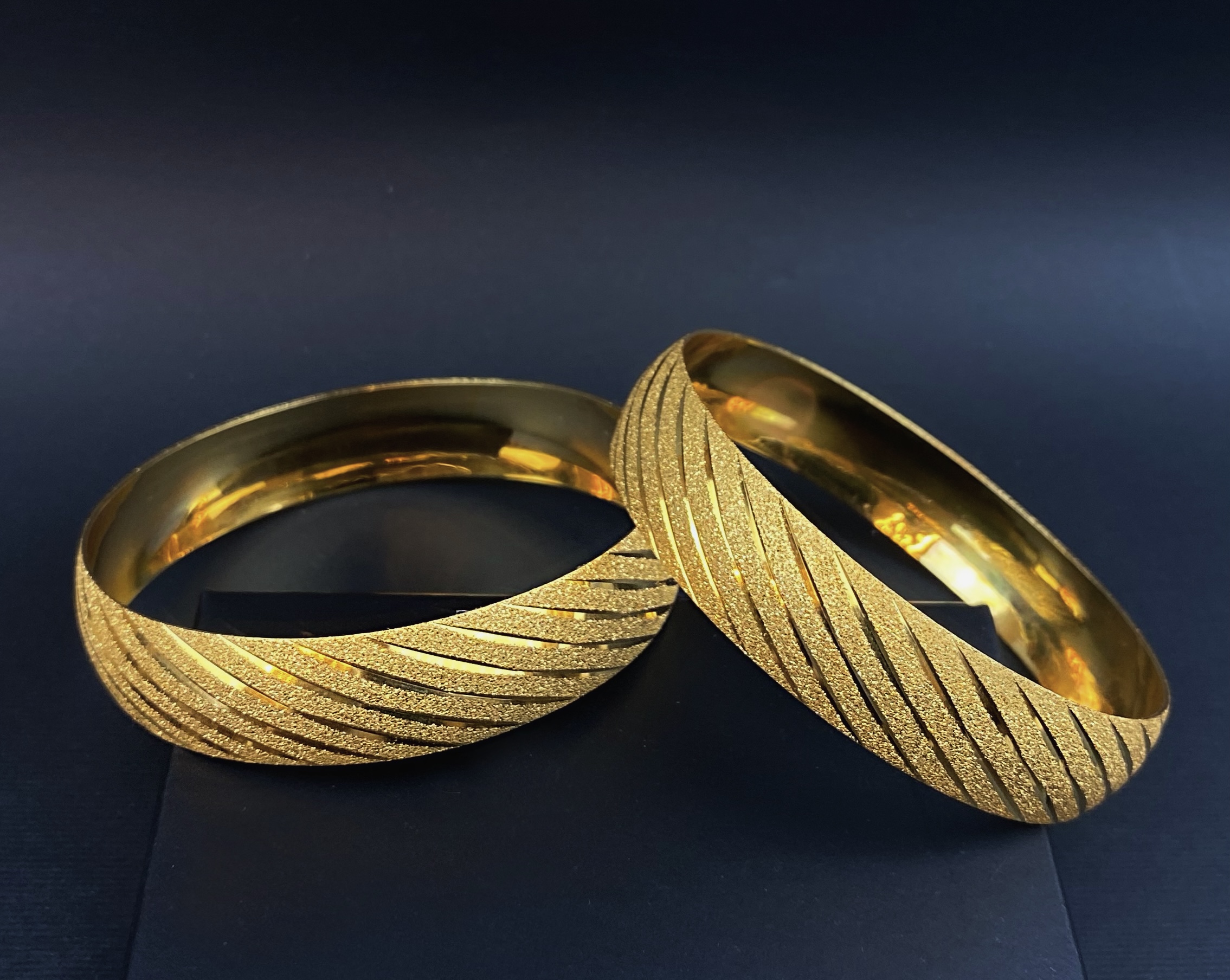
An ajda bilezik is a Turkish-style gold bracelet made from flat, interlocking link plates that sit tightly together and give the look of a wide, continuous band. The phrase gram fiyatı simply means 'gram price', so a search for ajda bilezik gram fiyatı 2026 is really a question about how much one gram of the gold inside that bracelet costs this year — and why the answer is never a single fixed number.
- A 22-karat gold alloy contains 91.6% fine gold by weight, while 18-karat contains 75.0%, 14-karat 58.5% and 9-karat 37.5%.
- Finished gold jewellery sold in the UK carries 20% VAT, whereas investment-grade gold bullion is exempt.
- Gold items weighing more than one gram must be hallmarked by one of the four UK Assay Offices: London, Birmingham, Sheffield or Edinburgh.
- Imitation and gold-plated bracelets contain no recoverable fine gold, so their retail prices do not track the London spot rate.
Table of Contents
- What Is an Ajda Bilezik?
- How Is the Ajda Bilezik Gram Price Calculated?
- Gold Price per Gram in 2026: What Sets the Number?
- Making Charges, VAT and Hallmarking in the UK
- Importing from Turkey: Duty and VAT
- Why Imitation Ajda Bilezik Prices Are Not Tied to Gold
- How to Compare Ajda Bilezik Prices Before You Buy
- Frequently Asked Questions
The confusion usually starts the moment you hold a jeweller's daily gold rate next to the gram prices you see at Mad Gold İmitasyon, where most pieces are imitation or plated rather than solid gold.
What Is an Ajda Bilezik?
An ajda bilezik is a Turkish link-style gold bracelet whose price is quoted mainly by the gold weight it contains, not by a fixed retail figure.
In the Turkish jewellery trade, ajda describes a wide bracelet built from flat links that overlap like roof tiles. The links are usually hollow or semi-hollow, so a bracelet that looks substantial on the wrist often weighs far less than a solid bangle of the same width.
That construction is the reason the gram price matters so much. Two ajda bracelets can look identical when worn, yet one may weigh 12 grams and the other 30. In any gold market, weight — not appearance — decides the largest part of the cost.
Widths are quoted in centimetres. A 1 cm ajda bilezik sits like a slim band, while 2 cm and 3 cm versions read as statement pieces. Buyers in the UK often confuse width with weight, but the two are completely independent.
It also helps to separate two very different products. A solid gold ajda bilezik is priced like bullion plus labour. A gold-plated or imitation ajda bilezik is priced like fashion jewellery, with no connection at all to the daily metal rate.
How Is the Ajda Bilezik Gram Price Calculated?
The gram price of a gold ajda bilezik is the daily fine-gold rate per gram multiplied by the alloy's purity factor and the weight, then increased by the maker's charge and VAT.
The core formula is simple: daily fine-gold rate per gram × purity factor × weight in grams, plus the maker's charge and any tax. Everything else a seller tells you is a variation on that equation.
The purity factor converts fine gold into the alloy actually used. A 22-karat bracelet contains 91.6% gold, so its metal value is the 24-karat rate multiplied by 0.916. An 18-karat piece uses 0.750, and 14-karat uses 0.585.
Making charges are where quotes diverge most. Turkish workshops often state labour as a percentage of the metal value, commonly a low single-digit figure for plain links. UK retailers more often quote a flat charge per gram or per piece, which is easier to compare across shops.
VAT is added last and is not negotiable. Once you know the fine-gold rate, the karat and the weight, you can rebuild any quote yourself and spot an inflated one within seconds.
Gold Price per Gram in 2026: What Sets the Number?
There is no official annual gold price, because the reference is the daily London spot quotation and each karat is a fixed fraction of it.
There is no official yearly gold price. The reference is the London spot quotation, published continuously by the London Bullion Market Association, and it changes on every trading day. Any '2026 price' you see is simply one day's snapshot.
Karat fractions are fixed, however, and they are what make per-gram maths possible. Fine gold at 24K is treated as 99.9%. Then 22K is 91.6%, 18K is 75.0%, 14K is 58.5% and 9K is 37.5%.
As a purely illustrative example, if the 24-karat rate were £70 per gram, one gram of 22-karat gold would carry about £64 of metal. A 20-gram ajda bilezik would then hold roughly £1,280 of gold before labour and VAT. That is arithmetic, not a quote.
Check the live rate before you negotiate, not after. A difference of £2 per gram on a 25-gram bracelet is £50, which is usually more than any discount a shop will offer on the day.
Making Charges, VAT and Hallmarking in the UK
UK buyers pay 20% VAT on finished gold jewellery, and any gold item weighing more than one gram must carry an Assay Office hallmark.
UK buyers pay 20% VAT on finished gold jewellery. Investment-grade gold bullion is exempt, but a bracelet is jewellery, so the tax applies to the full retail price, including the making charge.
Hallmarking is compulsory. Any gold item above one gram must be tested and stamped by one of the four UK Assay Offices — London, Birmingham, Sheffield or Edinburgh. The mark identifies the maker, the assay office and the exact fineness.
A hallmarked ajda bilezik gives you two details that matter: the true purity and the identity of the responsible maker. If a seller cannot show a hallmark, treat the piece as plated, whatever the label claims.
Importing from Turkey: Duty and VAT
Turkish-made gold jewellery can enter the UK at a reduced or zero tariff under the UK–Turkey trade agreement, but 20% import VAT still applies.
Gold jewellery made in Turkey is covered by the UK–Turkey trade agreement, so many items qualify for a reduced or zero tariff when the origin rules are met. Import VAT at 20% still applies to the consignment regardless.
Personal imports are treated differently from commercial ones. If you buy for resale, you will need a customs declaration, and the carrier will normally collect the VAT before delivery. Budget for that on top of the shop price.
Why Imitation Ajda Bilezik Prices Are Not Tied to Gold
Imitation ajda bracelets contain no fine gold, so their price reflects design, base metal and plating rather than the daily gram rate.
Imitation and gold-plated bracelets contain no fine gold, or only a microscopic layer of it. Their price is set by design, base metal, plating thickness and labour, so it does not rise when the spot rate rises.
That is not a drawback for every buyer. A plated bracelet delivers the same visual width and link pattern for a fraction of the cost, and it can be replaced several times before it equals the price of one solid gold piece.
What you give up is metal value. A plated bracelet has almost no resale or scrap value, so treat the purchase as a style decision rather than a savings decision.
How to Compare Ajda Bilezik Prices Before You Buy
To compare fairly, convert every quote into a price per gram of fine gold and check the hallmark and the making charge separately.
Convert each quote into a price per gram of fine gold. Subtract VAT, subtract the stated making charge, then divide by the weight. What remains should sit close to the published karat rate for that day.
Ask for the weight in writing and weigh the item yourself where possible. A reliable scale removes all doubt, and reputable sellers will not object to the request.
Finally, compare like with like. A 3 cm hollow link bracelet and a 1 cm solid band are different products, and the cheaper one per gram may simply be the more lightly built one.
That is exactly why two gold-plated bracelets of the same length can differ by several grams, and why the per-gram figure alone never tells you how much metal you are actually wearing.
Frequently Asked Questions
How much is an ajda bilezik per gram in 2026?
There is no single figure. Multiply the day's fine-gold rate per gram by the purity factor for the karat (0.916 for 22K, 0.750 for 18K, 0.585 for 14K), then add the maker's charge and 20% VAT in the UK.
Is an ajda bilezik real gold?
Some are solid 22K, 18K or 14K gold and carry a UK Assay Office hallmark; others are gold-plated or imitation and contain no recoverable fine gold. The hallmark, not the label, is the reliable indicator.
Does an ajda bilezik hold its value?
A solid gold one tracks the metal price, though you lose the making charge and the dealer's spread on resale. A plated or imitation bracelet has almost no resale value as scrap.
Do I pay customs charges when buying from Turkey?
Import VAT at 20% applies to the consignment, and duty may apply unless the Turkish origin of the goods is properly declared under the UK–Turkey trade agreement. Carriers usually collect the VAT before delivery.
Should I choose a hollow or a solid ajda bilezik?
Hollow links give a wider look for less weight, which lowers the metal cost but makes the bracelet easier to dent. Solid links cost more per gram of appearance but resist daily wear far better.
Weigh First, Compare Second
Before you compare any two bracelets, put the one you are considering on a kitchen scale, note the exact gram figure, and divide the asking price by that number so you are comparing real cost per gram rather than sticker price.
See more